NSW ROOF TILE PROFILE GUIDE
Trying to identify an old roof tile on a NSW home? The manufacturer name is useful, but it is only the beginning.
Across Sydney, the Central Coast, Newcastle, Lake Macquarie, Maitland and the Hunter, older homes still carry roof tiles made by Monier, Wunderlich, Boral, Bristile, Pioneer, Marley, Besser, Whitelaw, Hume and manufacturers that disappeared or changed ownership many years ago.
That becomes important when one tile breaks. A homeowner can remove a cracked tile, take it to a modern roofing supplier and discover that the profile has not been manufactured for 20 or 30 years. In other cases the manufacturer still exists, but a current tile carrying a familiar profile name may not necessarily be identical to the generation installed on the roof.
At Recycling Roof Tiles, we deal with this problem regularly. The name moulded into the back of a tile is valuable, but the exact profile, manufacturing generation, sidelock, nib arrangement, water channel and working dimensions ultimately determine what will fit.
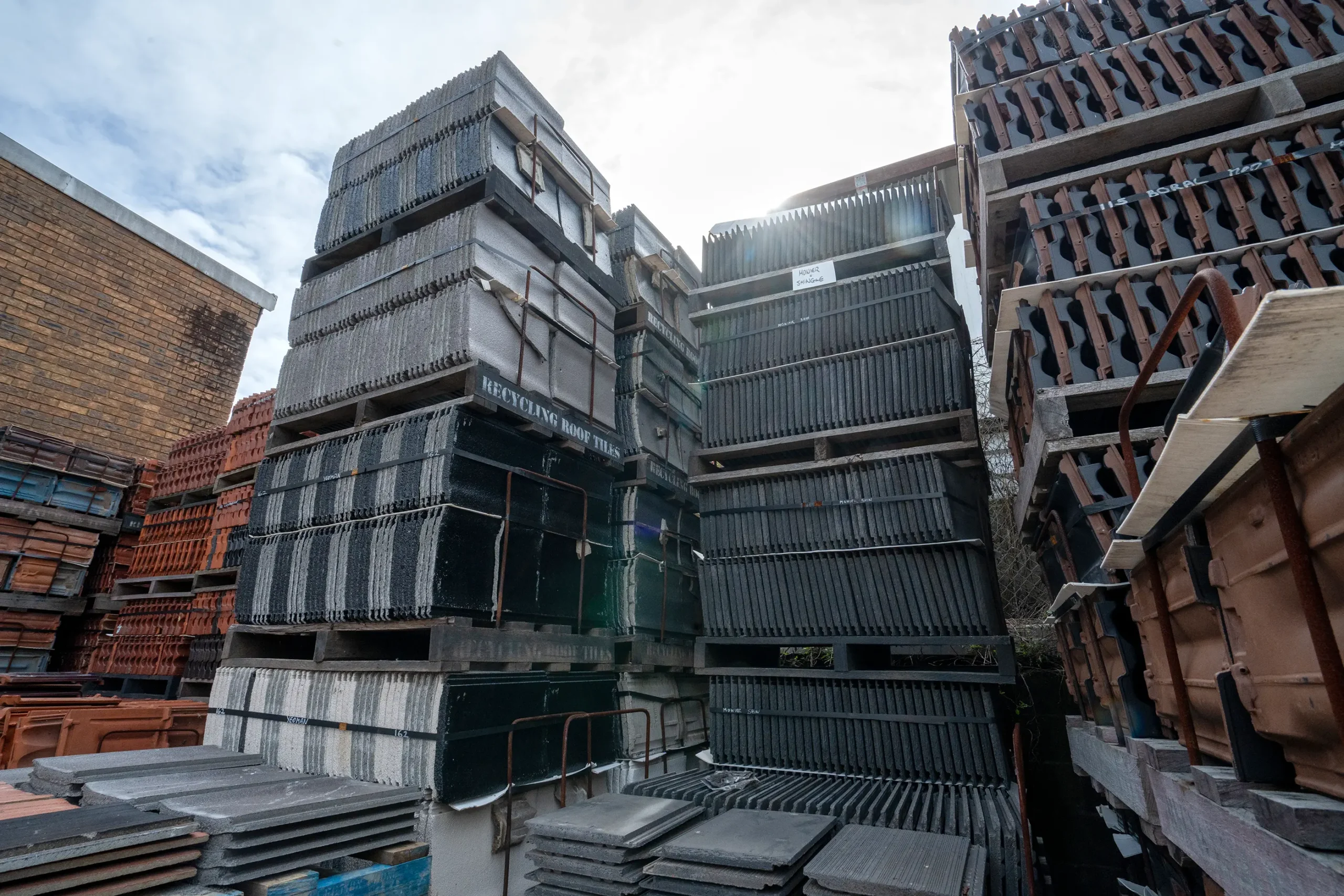
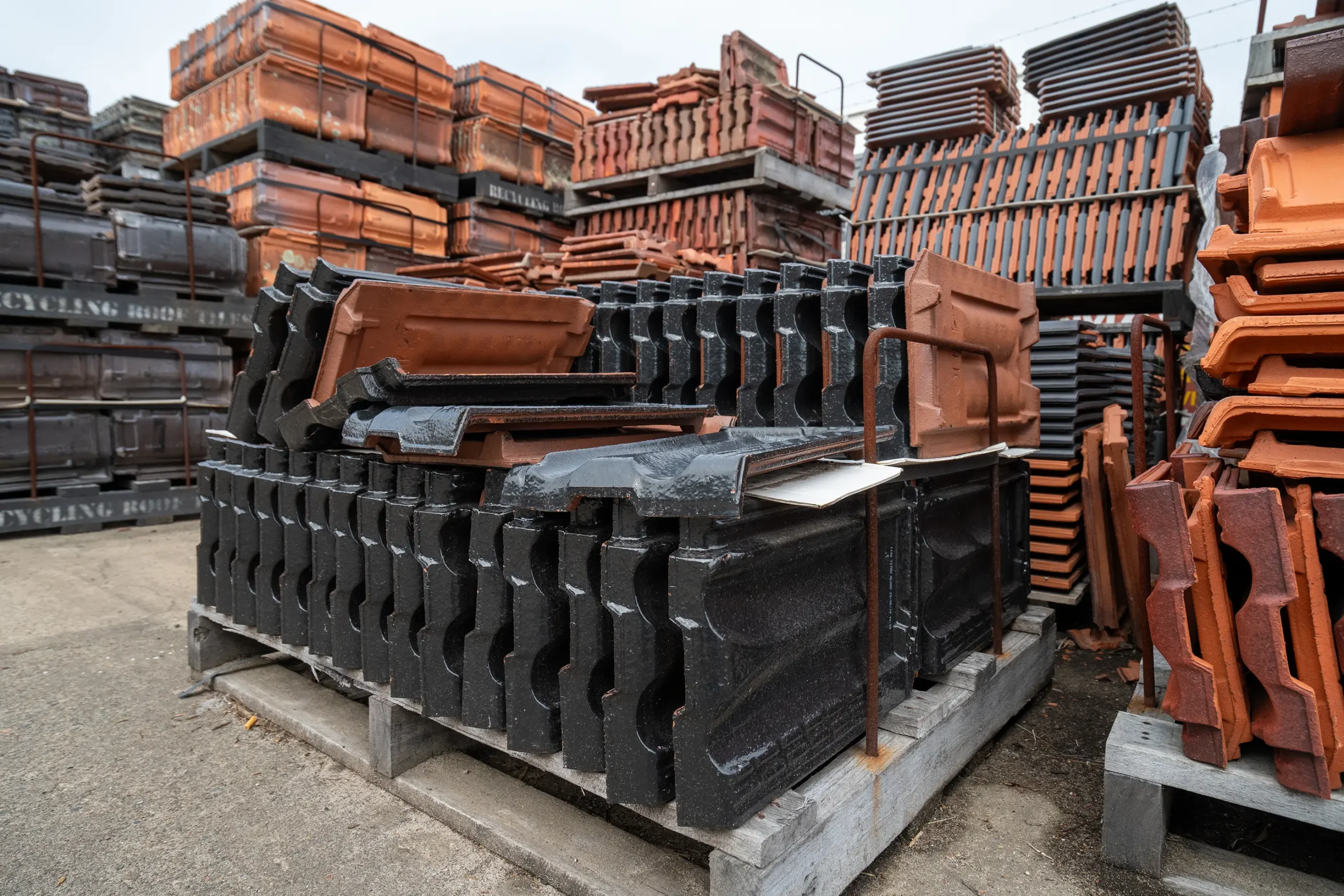
Older NSW roofs contain a surprisingly wide range of concrete and terracotta tile profiles. Once a profile stops being manufactured, recycled stock can become the only practical source of matching replacement tiles.
QUICK ANSWER
What Old Roof Tile Profiles Are Found on NSW Homes?
Older NSW roofs can contain concrete and terracotta tiles from Monier, Wunderlich, Boral, Bristile, Pioneer, Marley Reliance, Besser, Whitelaw, Hume, Clark, Redland, Karraman-Stuart, Atlas and other former Australian manufacturers.
Profile names that can appear when researching older Australian roofs include Monier Roman, Centurion, Monier 100, Tudor, Homestead, Traditional, Waverley, Elabana, Horizon, Marseille, Swiss, Boral Macquarie, Linea, Windsor, Modern French, Bristile Classic, Prestige, Pioneer Ranch, Chateau, Hacienda, Besser Viking and Marley Roman or Major, among many others.
This is not a substitution list. Two tiles appearing in the same historical family, carrying similar names or looking alike from the street does not prove they are interchangeable.
Before buying a replacement, compare the physical tile.
If you are starting with a completely unknown tile, our guide to identifying old roof tiles in NSW explains how to check the underside markings, dimensions, profile, sidelock, water channel and nibs.
Why NSW Has So Many Different Old Roof Tile Profiles
The variety comes from more than a century of changing building styles, manufacturers, acquisitions and product ranges.
Terracotta Marseille-pattern tiles became an important part of Australian residential roofing well before modern concrete roof tiles became widespread. Wunderlich became strongly associated with imported and later locally manufactured terracotta roofing, while other Australian manufacturers produced their own variations of familiar French, Marseille and Swiss-style patterns.
The University of Melbourne’s heritage building collection provides an excellent historical overview of Marseille roofing tiles in Australia, including how imported patterns developed into locally manufactured products.
Concrete roof tiles then became increasingly common during the twentieth century. Manufacturers developed flat, Roman, shingle, double-curve and other interlocking profiles. Companies merged, brands changed ownership and moulds evolved.
From the tile yard: The brand stamped into the back does not necessarily match the brand name a homeowner will see in a current catalogue. A Boral-era profile may now have a related name in another range, while older Wunderlich, Monier, Bristile and Pioneer histories can overlap.
Profile identification is therefore more useful than simply Googling the word stamped underneath the tile.
Start With Material, Profile and Working Geometry
The first distinction is material.
Concrete, often called cement roof tile in everyday Australian trade language, normally has a cementitious body with a surface coating or colour finish. Terracotta is fired clay and can often show the clay body through chips, broken edges or worn surfaces.
The second distinction is profile shape.
An old roof tile may be flat, shingle-like, semi-flat, Roman, double Roman, double-curve, French or Marseille patterned, Swiss-style or another shaped interlocking profile.
The third consideration is the working geometry.
Look at the sidelock, water channel, nib position, tile length and width, effective cover width and headlap. These determine how the tile actually relates to the battens and neighbouring tiles.
A tile can pass the first two tests and still fail the third.
The question is not simply:
“What tile looks like mine?”
The more useful question is:
“What tile will correctly engage with the roof I already have?”
Old Monier Roof Tile Profiles
Monier is one of the first names people encounter when identifying old concrete roof tiles in NSW.
Historical Australian roof tile references contain a much wider Monier family than today’s product catalogue. Older names include Roman, Centurion, Colortile, Homestead, Traditional, Waverley, Monier 100, Tudor, Swiss, Ranch, Hacienda and other generations and variants.
Monier Roman
Monier Roman is a familiar older raised concrete profile. Its visible wave makes it easier to recognise broadly than a flat tile, but that does not make matching automatic.
Different raised concrete profiles can appear remarkably similar from ground level. With a Roman tile, photograph the full underside and both side edges so the interlocking section can be compared.
If the tile is only being replaced because of isolated storm, tree or solar damage, finding the correct recycled Roman profile can avoid turning a small repair into a much larger roofing job.
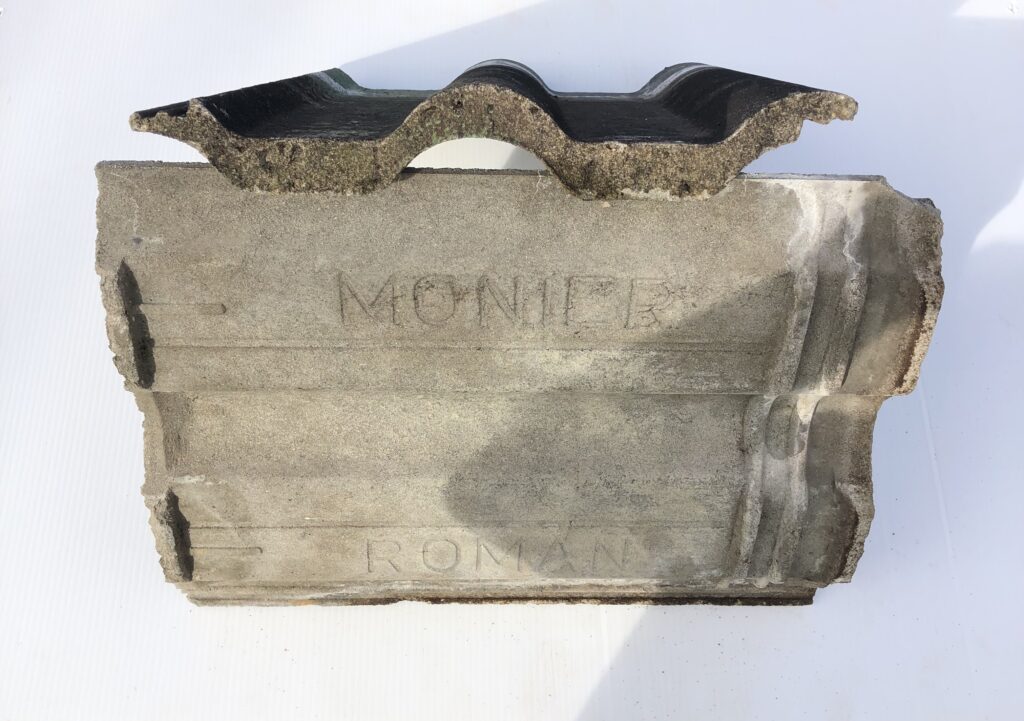
Monier Roman is one of the raised concrete profiles still encountered on established NSW tiled roofs. The visible face is useful, but the underside and sidelock are critical when matching a replacement.
Monier Centurion and Colortile
Centurion and Colortile are names that appear regularly in historical Australian tile references and recycled roof tile stock.
Besser Viking and Karraman-Stuart names can also appear when researching related older concrete tile families. These historical relationships are valuable identification clues, but they should not be treated as universal substitution instructions.
Changes in moulds, production periods and roof set-out can all matter.
Monier 100 and Tudor
The Monier 100 family is particularly useful for showing why the underside of a tile matters.
Older second-hand tile references distinguish different Monier 100 generations according to details moulded into the back of the tile, including reinforcement bars and other underside features.
This is why a photograph showing only the word “Monier” is rarely enough. Photograph the entire underside.
Two tiles can have almost the same identity in a search result and still require closer generation checking.
Monier Homestead and Traditional
Homestead and Traditional are names associated with lower, more restrained concrete profiles.
These can be deceptive because flatter tiles often look interchangeable in photographs. Small variations along the sidelock or underside can prevent a seemingly obvious replacement from sitting correctly.
Monier Waverley
Waverley is another older Monier name worth checking carefully rather than identifying purely by its upper face.
As with other old tiles, compare the markings, dimensions, nibs and interlocking geometry before selecting replacement stock.
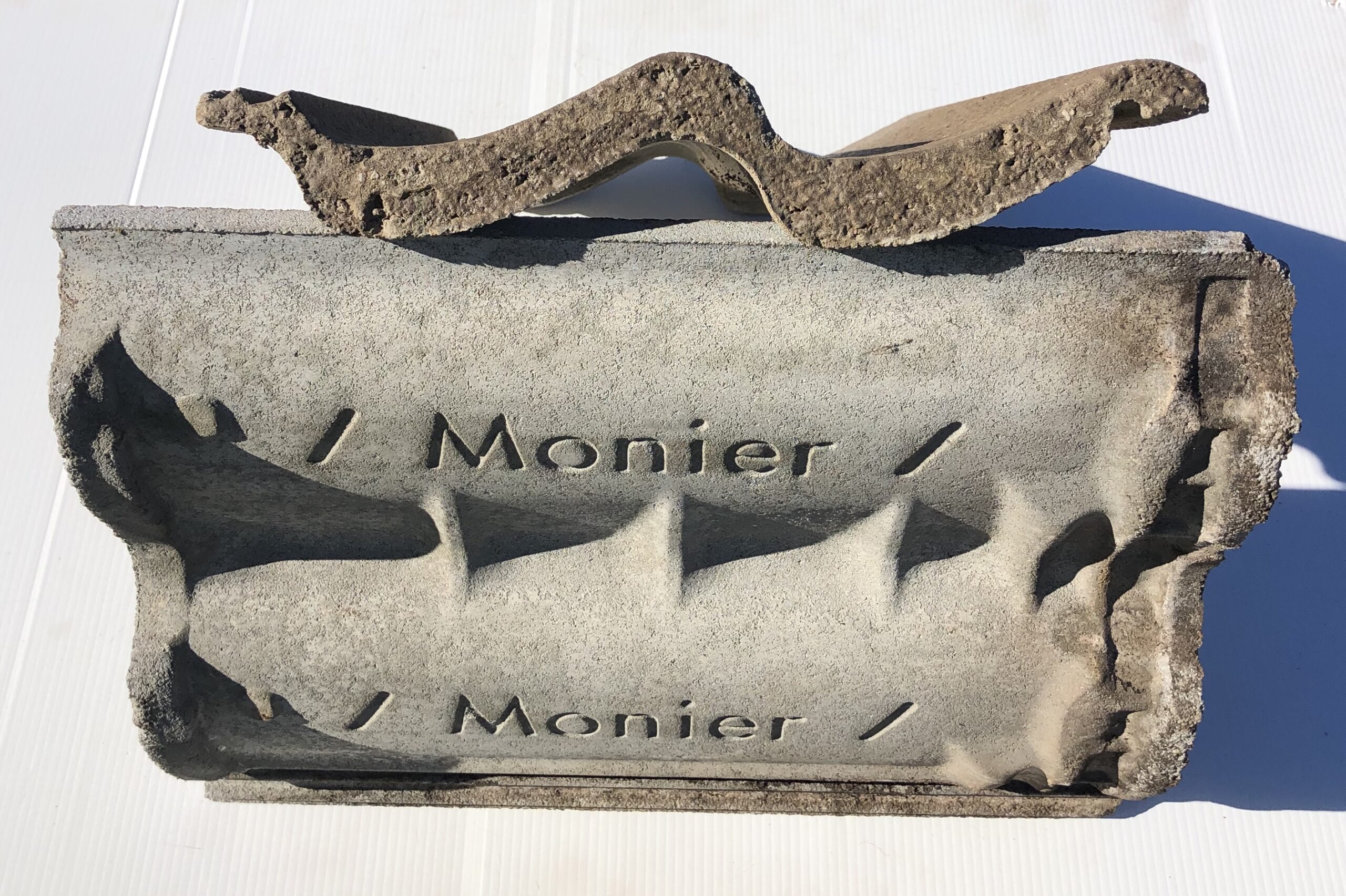
Old Monier profile names such as Waverley can remain useful identification clues long after the original product is no longer commonly found through ordinary new-tile distribution.
Elabana, Horizon, Tudor and Current Monier Profiles
An important correction to a lot of outdated roof tile information online is that not every old-looking Monier profile is discontinued.
Monier currently lists profiles including Horizon, Tudor, Elabana and Marseille within its Australian range. You can see Monier’s current profiles on the manufacturer’s Australian roof tile profile page.
That means finding an older Horizon, Tudor or Elabana roof does not justify automatically describing the profile itself as discontinued.
It also does not mean a tile purchased new today should automatically be dropped into an older roof carrying the same name.
The generation and physical fit still need to be checked.
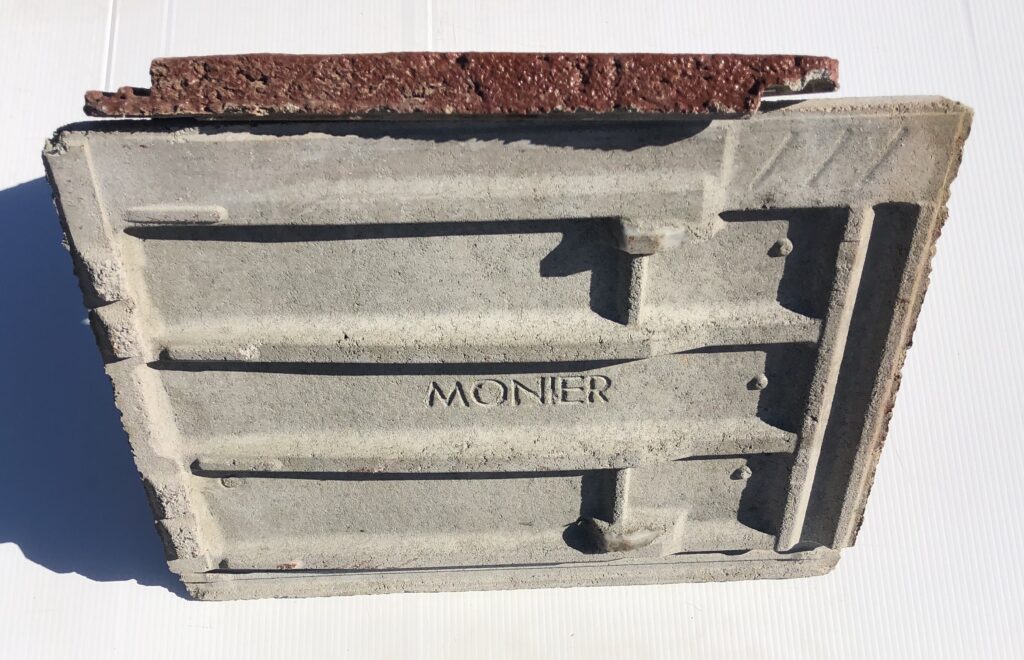
Horizon illustrates an important point: an established roof can carry an older tile while the broad profile name remains part of a current manufacturer’s range.
For a more detailed manufacturer-specific guide, see our resource on discontinued Monier roof tiles.
Wunderlich Terracotta Roof Tiles
Wunderlich is one of the most important names in Australian terracotta roofing history, particularly when identifying older Sydney and NSW homes.
The company became closely associated with Marseille-pattern terracotta roofing, first through imported tiles and later through Australian manufacturing.
For homeowners, the practical consequence is simple: “Wunderlich” on the underside can lead to several generations of terracotta tile rather than one universal profile.
Wunderlich Marseille and Modern French
Marseille or Modern French-style tiles are among the most recognisable old terracotta patterns.
They usually have a much more detailed face and interlocking arrangement than a simple flat concrete tile.
Historical Marseille tiles can also contain surprisingly useful markings. Manufacturer names, factory details, location marks and other impressions can appear moulded or pressed into the tile.
Do not assume every Marseille-pattern tile is interchangeable simply because the upper surface looks similar.
Marseille became so widespread that multiple manufacturers produced their own versions of the general pattern.
Wunderlich Swiss
Swiss is another name seen in older Australian terracotta identification material and recycled tile stock.
Again, the underside and exact fitting geometry matter more than a photograph found in an image search.
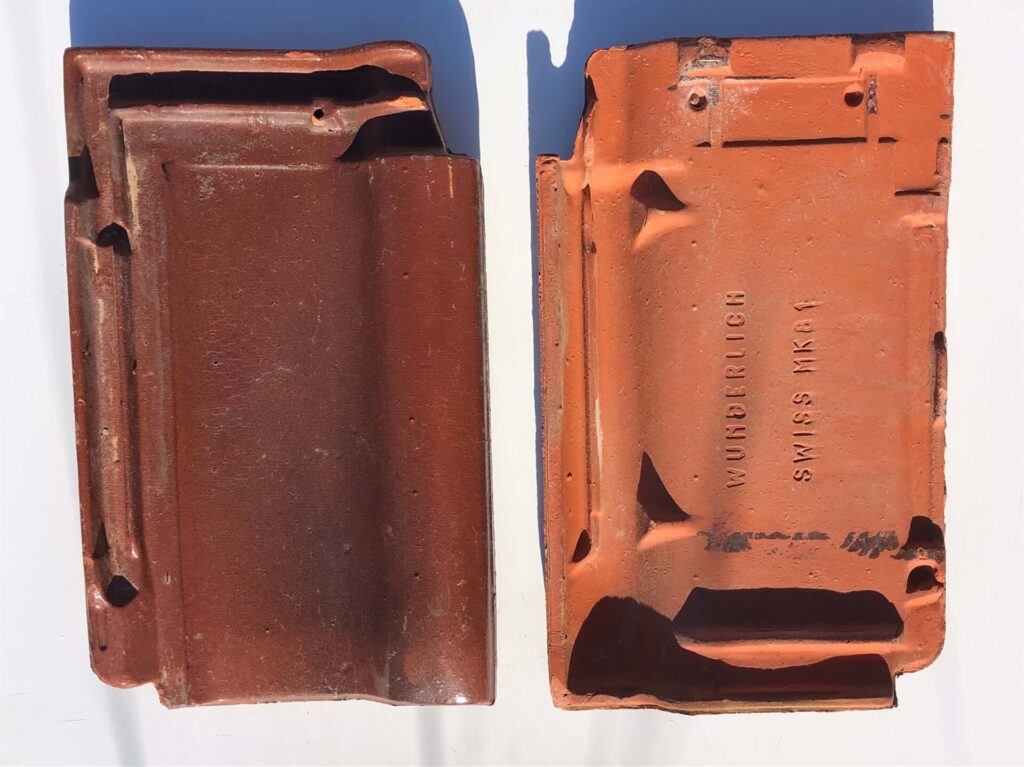
Older Monier and Wunderlich Swiss-style terracotta tiles show why manufacturer, profile and generation all matter when searching for replacement stock.
Other Wunderlich Generations
Historical roof tile references also contain other Wunderlich names and generations.
Where an unusual Wunderlich stamp appears, photographs of both faces and accurate measurements are particularly useful because the tile may be decades removed from anything found in a current product catalogue.
Old Boral Roof Tile Profiles
Boral is another name found across large numbers of older Australian tiled roofs, but there is an additional layer of history to consider.
Several profile names historically associated with Boral roofing are now found within the current LUTUM roofing range.
LUTUM currently lists concrete profiles including Capri, Contour, Linea, Macquarie, Slimline, Striata and Vogue, together with terracotta profile options. See the current LUTUM roofing range.
Identification trap: An old tile stamped Boral can belong to a profile name that still exists in a current range, but the old and current tiles should still be physically compared.
Boral Macquarie
Macquarie is one of the better-known shaped concrete roof tile names.
Historical Boral technical material describes Macquarie as a low double-curve concrete tile. The profile name remains present in the current LUTUM range.
If you have an old Boral Macquarie roof, this historical continuity is useful information, but do not rely on the name alone when replacing an individual tile from an older installation.
Boral Linea and Slimline
Linea and Slimline appear in historical Boral references and flat-profile discussions.
Flat tiles particularly expose the weakness of visual identification. Two flat concrete tiles can look nearly identical from above while their side engagement differs enough that one cannot correctly replace the other.
Boral Windsor
Windsor is another historical Boral profile name worth checking when identifying shaped older concrete stock.
As always, use the profile name to narrow the search, then confirm it against the actual tile.
Boral Modern French and Swiss
Older Boral ranges also included terracotta and terracotta-style profile names such as Modern French and Swiss.
That overlap in naming is another reason a search for “Swiss roof tile” or “French roof tile” is not enough. Manufacturer, material, generation and measurements should all be established.
Bristile Roof Tile Profiles
Bristile has produced both concrete and terracotta roofing, so an old Bristile tile should not be categorised by brand alone.
Current Bristile information for NSW includes concrete and terracotta profile families. Current technical information is available on the Bristile Roofing NSW technical information page.
Older NSW roofs can contain previous Bristile and Pioneer-era products that are no longer represented by the current catalogue.
Bristile Classic and Prestige
Classic and Prestige are useful names when identifying concrete Bristile tiles.
As with Monier, the current existence of a profile name does not establish that every historical generation is identical.
Bristile Marseille
Bristile also uses the Marseille name for terracotta roofing.
This gives us another reason not to identify a tile as simply “Marseille” and stop there. Marseille can describe a broad historical pattern, older Wunderlich products, Monier products and Bristile products.
The manufacturer and physical tile remain important.
Older Bristile and Pioneer Names
Historical second-hand roofing references associate Bristile and Pioneer with names including Chateau, Hacienda, Prestige, Ranch and Yeoman, including different versions of some profiles.
These are exactly the sorts of tiles that can be difficult to research through current manufacturer catalogues because the original product may have disappeared from retail supply many years ago.
Pioneer Roof Tiles
Pioneer tiles deserve separate mention because the Pioneer name can still turn up underneath older concrete roof tiles even where homeowners now associate similar products with Bristile or other manufacturers.
Historical profile references include names such as Pioneer Ranch, Chateau and Hacienda.
Do not immediately translate an old Pioneer stamp into a modern brand.
If the tile says Pioneer, photograph the Pioneer markings. That clue can help distinguish an original tile from a later product that merely resembles it.
Besser Roof Tiles
Older Besser concrete roof tiles also appear in recycled stock and historical Australian compatibility information.
A notable name is Besser Viking. Older references distinguish different versions according to fixing holes and other physical characteristics.
This is useful because it narrows the profile family, but it is still not enough by itself to prove compatibility.
Hole count, nib arrangement, dimensions and sidelocks should all be compared.
Marley and Marley Reliance Roof Tiles
Marley and Marley Reliance are names that can still appear when old concrete roof tiles are brought into recycling yards.
Historical Australian tile references include Marley names such as Major, Pantile and Roman.
Because “Roman” is also used more generally as a profile description and appears in other manufacturer ranges, a search for “Roman roof tile” can return several different products.
Useful identification rule: “Monier Roman” or “Marley Roman” is far more useful than simply “Roman tile”. Always pair the profile name with the manufacturer when you can.
Whitelaw Roof Tiles
Whitelaw is another brand found in historical Australian roofing references.
Older cross-reference material connects some Whitelaw names to profile families produced by other manufacturers, but this is an area where matching the physical sample is much safer than relying solely on an online compatibility statement.
Changes in moulds and generations are one reason specialist recycled roof tile suppliers retain physical stock for comparison.
Karraman-Stuart Roof Tiles
The Karraman and Stuart names are less familiar to many homeowners, but older Australian profile charts include Karraman and Stuart products alongside better-known concrete tile families.
Finding an unfamiliar manufacturer name is not necessarily bad news.
In fact, a distinctive underside stamp can make identification easier because it reduces the number of possible profiles.
Hume, Clark, Redland, Reliance, Atlas and Other Old Roof Tile Brands
NSW roofs are not limited to the four large names most homeowners recognise.
Older recycled stock and Australian roof tile references can also include names such as Reliance, Clark, Marley Reliance, Hume, Whitelaw, Besser, Jay Tiles, Karraman-Stuart, Redland, Atlas, Pegson and other former manufacturers.
This wider range is one of the reasons we do not recommend scrolling through a handful of “common roof tile types” online and choosing the closest photograph.
The Australian market has contained too many profiles over too many decades for that method to be reliable.
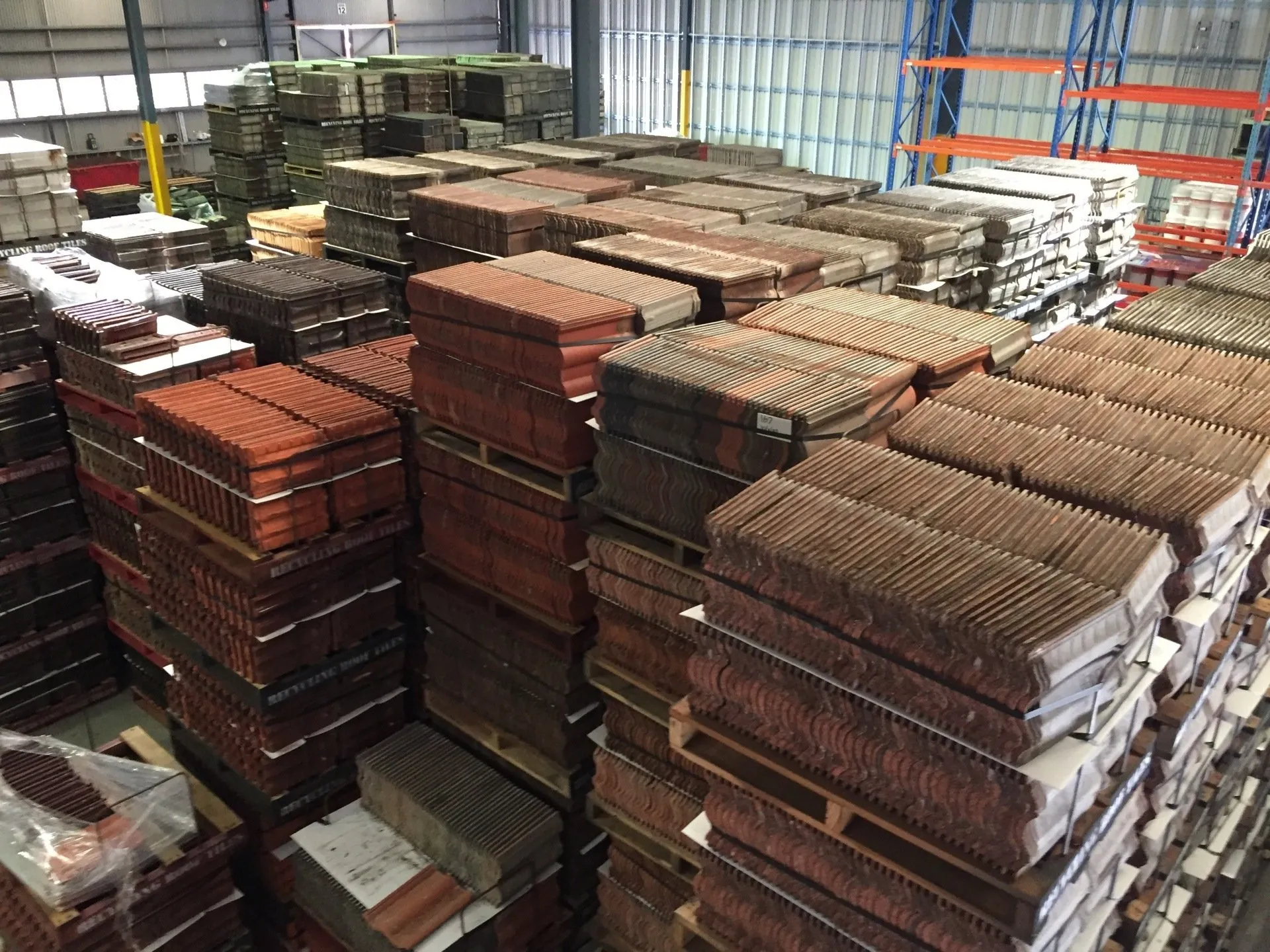
Terracotta roofing is particularly diverse because Australian roofs can contain tiles from different manufacturers, production periods and variations of familiar French, Marseille and Swiss-style profiles.
A Roof Tile Name Can Mean Three Different Things
This is one of the most useful concepts when identifying an old tile.
When someone says, “I have Marseille tiles”, they may be describing the shape.
When they say, “I have Wunderlich Marseille”, they may be describing a manufacturer and historical profile.
When they say, “Monier still makes Marseille”, they are discussing a current product.
Those statements can all be true without the three tiles being automatically interchangeable.
The same problem occurs with names such as Roman, Swiss, Tudor, Horizon, Macquarie and other long-running profile names.
A useful way to think about identification is:
Brand → Profile → Generation → Physical Fit
rather than:
Name → Buy Tile
Why the Back of an Old Roof Tile Is So Valuable
The face of a roof tile was designed to be seen.
The back was designed to make it work.
That makes the underside extremely useful for identification.
Look for moulded manufacturer names, profile names, numbers, fixing holes, reinforcement ribs, bars, nibs and the shape of the sidelock.
Those details are often impossible to establish from a photograph of a completed roof.
If you have a spare tile stored in a garage, shed or under the house, it is often the best identification sample you have.
How to Photograph an Old Roof Tile for Identification
If a loose tile can be accessed safely, send photographs showing:
- The complete top face.
- The entire underside.
- A side-on view of the profile.
- Close-ups of all names, numbers and moulded markings.
- Both side interlocks.
- The nibs and top edge.
- The tile beside a tape measure showing overall length and width.
- A wider photograph showing several installed tiles together.
Your suburb and the approximate age of the house can also help narrow the possibilities.
Do not climb onto an unsafe roof just to obtain a photograph. If there is no safely accessible spare tile, have the roof inspected or the sample removed by someone experienced in roof access.
Is an Old Roof Tile Automatically Discontinued?
No.
“Old” and “discontinued” are not the same thing. A profile name can remain in production even when a particular roof has been carrying that profile for decades.
Monier currently manufactures several profile names that are also encountered on established roofs. LUTUM similarly carries profile names strongly associated with earlier Boral roofing ranges, while Bristile continues to manufacture long-established concrete and terracotta profile families.
So the better questions are:
Is my exact generation still manufactured?
and:
Will the current version physically fit my existing roof?
Those questions are much more useful than asking only whether the profile name still exists.
Can Different Brands of Roof Tile Be Interchangeable?
Sometimes closely related historical profiles can fit one another, and old roofing charts document a number of cross-brand relationships.
However, we would not recommend choosing a replacement on the basis of a historical compatibility table alone.
Those records can be extremely useful for narrowing the identification, but they are not universal guarantees.
A replacement should still be physically checked against the original tile and, where appropriate, against the roof itself.
Why Recycled Tiles Become More Valuable as Profiles Get Older
When a manufacturer retires a mould, there is no warehouse producing unlimited replacement tiles for the next 40 years.
The remaining supply gradually comes from existing roofs.
Tiles recovered during demolition, alterations and reroofing can be sorted rather than crushed or sent to waste. Those tiles then become spare parts for other buildings still using the same profile.
That is why an old tile that appears worthless during demolition can be surprisingly valuable to someone who needs four of them to repair a roof across town.
Once a roof tile profile disappears from new production, recovered stock effectively becomes replacement parts for other NSW homes still using the same tile.
For more on how this works, see our guide to recycled roof tiles in Australia.
Where We See Old Roof Tile Profiles Across NSW
Older tile profiles are not limited to heritage terraces or inner-city houses.
Across Sydney they remain common on established homes through the northern suburbs, Hills District, western suburbs, southern suburbs and older coastal areas. Hornsby and its surrounding suburbs contain a mixture of older terracotta and later concrete tiled roofs.
The Central Coast has decades of tiled housing stock through Gosford, Kincumber, Wyong, Woy Woy, Erina, Tuggerah, Toukley, Doyalson and surrounding suburbs.
North of the Central Coast, older profiles regularly turn up around Newcastle, Lake Macquarie, Maitland, Cessnock, the Hunter Valley and Port Stephens.
Location helps identification, but it does not replace the tile itself. Two homes built in the same street can have completely different profiles because of builder choice, construction year, supplier relationships or later repairs.
Where Can You Find Replacement Tiles for an Old NSW Roof?
If the exact profile is still current, the manufacturer or a roofing supplier may be able to supply the tile.
If it has been discontinued, a specialist second-hand or recycled roof tile supplier is usually the logical place to start.
Recycling Roof Tiles operates from Doyalson and supplies old and replacement tiles for customers across the Central Coast, Sydney, Newcastle and surrounding NSW regions.
We can often begin identification from photographs before you travel.
See our spare and replacement roof tiles NSW service or our roof tile matching service in Sydney if you already have a broken sample or clear photographs.
You can also explore our information on second-hand concrete and cement roof tiles and recycled terracotta roof tiles.
Should You Replace the Whole Roof if You Cannot Find the Profile?
Not automatically.
A discontinued tile is a parts-availability issue. It is not by itself evidence that a roof has reached the end of its useful life.
If the structure and the majority of the tiles remain serviceable, locating the correct reclaimed profile may allow a roofer to repair a relatively small damaged area.
A different discussion is required where tiles are failing throughout the roof, battens or structure require major work, the roof is being substantially altered or suitable replacement stock can no longer reasonably support ongoing maintenance.
Identify the tile before deciding what the roof needs.
Frequently Asked Questions About Old Roof Tile Profiles
How do I identify the brand of an old roof tile?
Look underneath a safely accessible spare or loose tile for a manufacturer stamp, logo, profile name, number or moulded code. Common NSW names include Monier, Wunderlich, Boral, Bristile, Pioneer, Marley, Besser, Hume and Whitelaw. The manufacturer marking should then be checked against the profile shape, dimensions, interlocks and nib arrangement.
What are some common old Monier roof tile profiles?
Older Monier references include Roman, Centurion, Colortile, Homestead, Traditional, Monier 100, Tudor, Waverley and several other profile families. Some names such as Horizon, Tudor and Elabana also exist in Monier’s current range, so an old tile should not automatically be described as discontinued.
What are Wunderlich roof tiles?
Wunderlich was a major Australian building-products company closely associated with terracotta roofing. Older Wunderlich Marseille, Modern French, Swiss and other terracotta products can still be found on Australian roofs. The exact generation should be identified before a replacement is selected.
Are old Boral roof tiles still available?
Some profile names historically associated with Boral roofing continue within today’s LUTUM range, including Macquarie and Linea. That does not mean every old Boral tile is identical to a current tile carrying the same profile name, so compatibility should still be checked physically.
How can I tell a Bristile tile from a Monier tile?
The underside stamp is usually the strongest starting clue. After establishing the manufacturer, compare the profile, dimensions, sidelock, water channel and nib arrangement. Do not rely on the visible face or colour alone because different manufacturers produced visually similar profiles.
Are old terracotta roof tiles worth keeping?
Yes, particularly if they are sound and belong to a difficult-to-find profile. Spare tiles from an existing roof can be extremely useful for future repairs, while sound recovered tiles can also become replacement stock for other roofs using the same profile.
Can I use a roof tile that is nearly the same shape?
Not without confirming the fit. A tile that is only slightly different can sit high, rock, interfere with neighbouring tiles or alter the overlap and drainage path. The sidelock, nibs, cover width and headlap relationship matter.
Can a different brand replace my old roof tile?
Sometimes closely related historical profiles can be compatible, but this should be confirmed physically rather than assumed from appearance or an old compatibility chart. Similarity does not guarantee correct engagement with the surrounding roof tiles.
Is an old Monier, Boral or Bristile tile automatically discontinued?
No. Some profile names have remained in production for many years or continue under current product ranges. The important question is whether the exact generation on your roof remains available and whether a current version physically matches the existing installation.
Where can I buy old roof tiles in NSW?
Specialist recycled roof tile suppliers are generally the best place to look once a profile is no longer available new. Recycling Roof Tiles supplies old and replacement concrete and terracotta profiles from Doyalson to customers across the Central Coast, Sydney, Newcastle, Hunter and surrounding NSW areas.
What photos should I send when trying to identify an old roof tile?
Send a photograph of the complete top, full underside, side profile, all manufacturer markings, both interlocking edges and the tile beside a tape measure. If possible, also include a wider photograph showing how several original tiles sit together on the roof.
TILE IDENTIFICATION HELP
Need Help Identifying an Old Roof Tile?
If you have a tile stamped Monier, Wunderlich, Boral, Bristile, Pioneer, Marley, Reliance, Besser, Whitelaw, Hume, Clark, Redland, Karraman, Stuart, Atlas or another name you do not recognise, do not buy the first tile online that looks close.
Send us clear photographs of the top, complete underside, side profile, markings and dimensions.
Recycling Roof Tiles deals with old Australian roof tile profiles and replacement stock from our Doyalson yard. We can compare your sample with known profiles and available recycled tiles and help establish what you actually need.