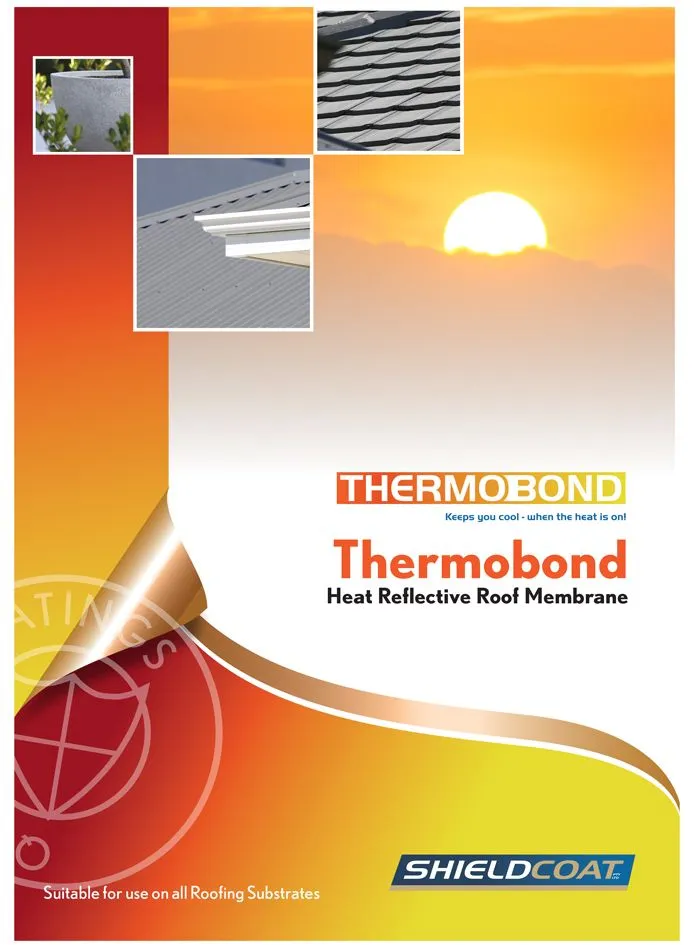
Thermobond heat reflective roofing membrane

SC Thermobond Brochure

Thermobond HRC

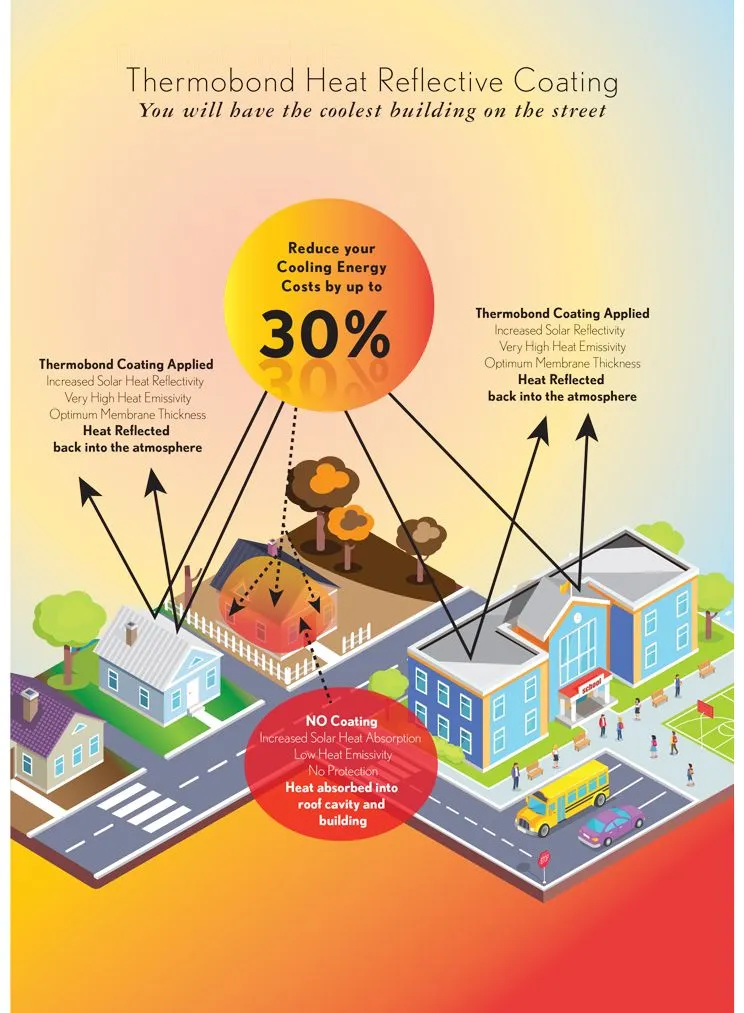
For almost 20 years Thermobond has been used as a solution for electricity cost and heat reduction throughout Australia and the world. Cooling energy cost reductions of 25-30%pa are achieved on numerous building types such as shopping centers, universities, schools, libraries and air-conditioned warehouses.

Significant interior temperature reduction is achieved on anything from piggeries/chicken sheds to shipping containers and even silos. Thermobond can be applied to anything that would benefit from a reduction in temperatures as a result of direct sunlight. 

Thermobond operates on three levels, solar reflectivity, very high heat emissivity and membrane thickness. This means Thermobond does not allow the passage of heat from the sun to reach the substrate it has been installed on. 

Application is non-disruptive to business, requires little to no maintenance and is backed up by a comprehensive 10 year guarantee.

The following pages include case studies from a two year independent study carried out by the Queensland University of Technology, commissioned by Ergon Energy. Thermobond HRC was the product chosen to be used in the study.

Guaranteed electricity cost savings Proven peak energy demand reduction Independently tested by QUT and Ergon Energy Reduced carbon footprint Lower air-conditioning running times Increased life of building materials Cooler working/living environment Easily applied Minimal maintenance
Cooling energy cost reductions of 25-30%pa

Currently used on School Buildings, New Homes and Restorations through out Queensland

  • Internal aluminium mesh 
  • Fully self-adhesive butyl backing
  • Creped aluminium surface
  • Can be used as part of a BAL 19 system
  • Complies with AS/NZS 4020:2005 ‘Testing of products for use in contact with drinking water’
  • Only to be used on a roof pitch of at least 12°
DAKAFLASH is the best value lead free flashing available in Australia, and brought to you by the same German manufacturer and Australian distributor that brought you WAKAFLEX.

DAKAFLASH utilises the same inner mesh as WAKAFLEX; for strength and durability, and the same butyl and top sheet technology as SMARTFORM; for ease of installation and UV resistance. DAKAFLASH offers you all of these benefits as well as being up to 30% cheaper than lead.

Compare your cost per lineal metre. See how much you’ll save!!!

DAKAFLASH is the perfect flashing for new build homes, flashing around a chimney or abutment, or repairing a faulty lead flashing. Evo Building Products is confident that you’ll agree; DAKAFLASH is now the best value flashing

available in Australia.

Give us a call for a free of charge, no obligation free sample to see what you think.
  • How to Clean Terracotta Roof Tiles Safely (Without Pressure Washing)

    How to Clean Terracotta Roof Tiles Safely (Without Pressure Washing)

    TERRACOTTA ROOF CARE GUIDE The most common advice for cleaning terracotta roof tiles, pressure washing, is also the method most likely to damage them. High-pressure water strips the tile’s protective surface, forces moisture under the tiles, and often makes moss and lichen come back faster and thicker than…

  • Roof Paint Types Explained: Concrete, Terracotta and Metal Coating Systems Compared

    Roof Paint Types Explained: Concrete, Terracotta and Metal Coating Systems Compared

    TECHNICAL REFERENCE GUIDE Concrete tiles, terracotta tiles and metal roofing do not use the same coating system, and treating them as interchangeable is the single biggest cause of early coating failure. Each substrate has a different porosity, a different failure mode and a different primer chemistry it needs…

  • Roof Tile Painting Cost NSW: Full Price Guide, Coating Lifespan and What Actually Drives the Cost

    Roof Tile Painting Cost NSW: Full Price Guide, Coating Lifespan and What Actually Drives the Cost

    ROOF PAINT COST GUIDE A tile roof paint job in NSW typically runs from around $18 to $60 per square metre, depending on tile type, roof condition and access. Most standard homes land somewhere between $3,000 and $9,000 for a full repaint. But the price per litre on…

  • Genuine Match vs Near-Match Roof Tiles: Which Should You Use?

    Genuine Match vs Near-Match Roof Tiles: Which Should You Use?

    TILE MATCHING COMPARISON A genuine matching profile and a near-match substitute can look almost identical from the ground and behave completely differently on the roof. The genuine match shares the same sidelock, water channel and cover width as the surrounding tiles, so it seats, drains and weathers the…

  • Roof Tile Bedding and Pointing: When Should You Repoint or Rebed?

    Roof Tile Bedding and Pointing: When Should You Repoint or Rebed?

    RIDGE CAPPING REPAIR GUIDE Roof bedding supports your ridge caps. Roof pointing is the exposed finishing layer that bonds and seals around them. If the pointing has deteriorated but the bedding underneath remains firm, repointing may be enough. If ridge caps are loose or the bedding is crumbling,…

  • Can You Replace Just a Few Roof Tiles? When a Matching Repair Beats a Full Reroof

    Can You Replace Just a Few Roof Tiles? When a Matching Repair Beats a Full Reroof

    ROOF TILE REPAIR GUIDE Yes, you can often replace just one, two or a handful of roof tiles. If the surrounding roof is sound and the damage is genuinely localised, finding the correct matching tile is usually more sensible than disturbing an otherwise serviceable tiled roof. The important…